



Architecture Thesis Projects – A Comprehensive Guide
Architecture thesis projects are an essential part of an architecture student’s educational path. These projects go beyond classroom assignments; they reflect a student’s creativity, design thinking, and ability to conduct meaningful research. A good architecture thesis paper helps architecture students pursue their interests while simultaneously working towards a solution to a practical architectural problem.
Selecting the right topic to base the project upon is of the utmost importance since the project will not only be a part of the academic curriculum of the student but will also be part of the architecture student's portfolio
Understanding Architecture Thesis Projects
An architecture thesis project is a key academic milestone that combines creativity, research, and expertise. It covers conceptual design, site analysis, technical detailing, and problem-solving. Students must produce a professional-quality thesis paper showcasing originality, critical thinking, and practical solutions. A clear structure guides the project from research to final presentation, ensuring all sections are aligned and effective.
Definition and Purpose of Architecture Thesis
An architecture thesis has the first goal, which is scholarly. In academic circles, it shows the ability of a student to undertake autonomous research and manufacture piece of evidence research solutions. Architecturally, it demonstrates design thinking, creativity, and preparation to real world architectural problems.
Core Components of a Thesis Project
A strong architecture thesis project relies on several key components:
-
Research Design and literature review to understand precedent studies, theoretical frameworks, and regional context.
-
A well-developed design proposal that outlines the project objectives and conceptual approach.
-
Research analysis to evaluate site conditions, materials, and social or environmental factors.
-
Concept development through sketches, diagrams, and physical or digital models to visualize ideas.
-
Drawings, 3D models, and simulations that refine design solutions and explore technical feasibility.
-
Comprehensive documentation, including the final thesis paper, presentation boards, and diagrams.
Importance of Originality and Research
A good architecture thesis needs to utilize the element of originality. A creative thought is what catches the attention, and good research work will help ensure that the answers are viable. Avoiding plagiarism will help in making the architecture thesis paper validated and professional.
Types of Architecture Thesis Projects
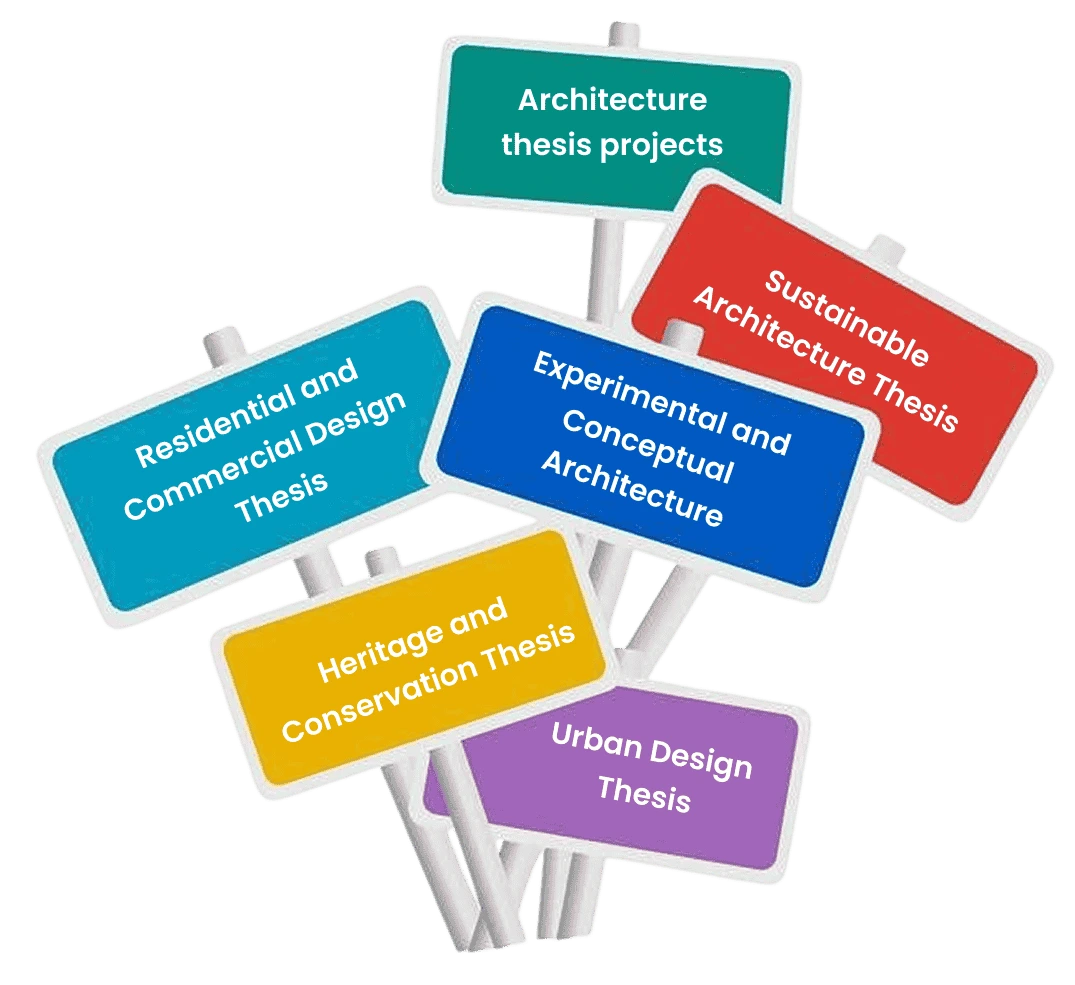
Architecture thesis projects differ based on a student’s interests, focus, and chosen theme. Knowing the different types helps students pick a topic that fits their academic objectives and personal strengths, with each type presenting its own challenges and learning opportunities
Urban Design Thesis – Focuses on city planning, public spaces, and community design. Students may revitalize neighborhoods, improve transportation systems, or design urban parks. Challenges include managing regulations, social needs, and spatial constraints. Learning outcomes include urban analysis, socio-economic evaluation, and community engagement.
Example: redevelopment of Mumbai’s waterfront or pedestrian-friendly districts in Copenhagen.
Sustainable Architecture Thesis – Centers on green buildings, energy efficiency, and eco-friendly materials. Projects may involve net-zero buildings, passive cooling strategies, or renewable energy integration. Challenges include technical feasibility and resource management. Students gain skills in environmental analysis and sustainable design.
Example: eco-friendly housing in Delhi or solar-powered office complexes in Berlin.
Heritage and Conservation Thesis – Involves restoration, adaptive reuse, and designing within historical contexts. Challenges include preserving cultural identity while introducing innovation. Learning outcomes: historical research, material analysis, and sensitive design.
Example: restoring colonial-era buildings in India or converting European warehouses into cultural spaces.
Residential and Commercial Design Thesis: Focuses on housing, offices, or mixed-use spaces. Students balance functionality, comfort, and innovation.
Example: Modular apartments in Mumbai, co-living spaces in Singapore, or mixed-use complexes in London. Skills learned include spatial planning, project management, and user-centric design.
Experimental and Conceptual Architecture: Includes futuristic, parametric, or theoretical projects. Students explore untested ideas and speculative designs.
Example: Floating cities in the Netherlands or Mars habitat proposals. Challenges include conceptual innovation and material experimentation; learning outcomes focus on creative problem-solving and forward-thinking design.
How to Choose the Right Architecture Thesis Project
Identifying the appropriate architecture thesis project is a measure of academic achievement and personal development. The chosen topic properly makes sure that your work is representative of your interests, and that it is up to academic standards and that your portfolio is more robust.
Self-Evaluation of Strengths and Interests
Specialize in what you like or have skills in, either in the field of urban design, sustainable architecture, heritage conservation, or experimental projects. Choose the subject matter that you are best at in order to have a positive experience and deliver.
Needs and Current Trends
Discovering such emerging trends as smart cities, green design, reuse with adaptation, and culturally sensitive architecture. Being aware of what is as well assists your project in maintaining its influence and innovativeness.
Evaluate Feasibility
Think about the resources available, the budget, access to the site and the faculty. Such an effective strategy will avoid time loss and guarantee successful project execution.
Align with Career Goals
Select a subject that functions as an addition to your portfolio and, therefore a boost to your future career path. This will make your thesis both relevant to your academics and profession.
Steps to Develop an Architecture Thesis Project
Writing an architecture thesis project requires a step which is to be done. This makes the end product coherent, research-oriented, and design-oriented. The stages are progressive and enable students to build upon each other in the process of developing their ideas in a structurally sound manner to create a dissertation paper that is of a professional level.
Topic Selection and Proposal Writing
Start with an effective research question and balance out your goals of the project. A good proposal must detail the scope, methodology and anticipated results. It draws attention to the project and makes it manageable. This step predetermines all that is ahead.
Research and Case Studies
Conduct a review of the study, examine the site, and review the literature. The information about similar projects, the local situation, and technical constraints will help you develop informed design solutions. It is a stage that builds the ability to think analytically and critically.
Concept Development
Test the numerous design ideas using brainstorming, sketching, and conceptual modeling. Students are taught to imagine abstract things and analyze innovative solutions and subsequently make decisions.
Design Development
Eschew into sufficient drawings, 3D, and simulation of concept. Arrangement of plans, selection of materials, and space. The difficulty lies in the design to strike the right balance between functionality, beauty and technical feasibility.
Documentation and Presentation
Compile your work into a polished thesis report, diagrams, boards, and presentation materials. This final stage emphasizes clarity, organization, and the ability to communicate design intent effectively to faculty and peers.
Professional Support for Architecture Thesis Projects
Many students seek professional guidance to ensure the success of their architecture thesis projects. Our Thesis writing services provide structured support while allowing students to retain originality and creativity. Writing a thesis can be organized with the support of thesis writers, but students can retain originality and creativity. They tend to outsource such services to assist in some of the tricky research, design problems, or write quality documentation.
The most important areas in which professional assistance is useful:
Concept Refinement and Topic Finalization: Professionals aid in the process of making broad concepts practical and establishing entailed research objectives.
Research and Case Study Support: This involves advice on literature reviews, site analysis and precedent studies that guide design decisions.
Design Development and Planning Guidance: Support is aimed to perfect concepts, layouts, technical feasibility, as well as aesthetic feasibility.
Documentation, Drawings, and Presentation Support: The help includes elaborate drawings, 3-D models, and even the thesis paper.
Improving Academic Clarity and Submission Quality: Professionals recommend the structure of the report, clear writing, compliance with standards, and timeline efficiency.
Professional assistance will allow the students to break the barriers, to remain concentrated, and present a high-grade thesis, which is well documented.
Tools and Resources for Architecture Thesis Projects
Architecture students require reliable and efficient tools and resources to complete an architecture thesis successfully.
Design Software: AutoCAD, Revit, SketchUp, and Rhino will enable you to make correct 2D plans, detailed 3D models and a realistic simulation of your designs.
Databases and journals in research: It provides the students with access to academic articles, design journals, and case studies, which give them the data necessary to investigate precedent projects and provide more weight to the design rationale.
Standards and Building Codes: Understanding local and international building codes can make you safe in assuring that your designs are safe, functional and that they meet the legal and technical standards.
Online Architecture Thesis Repositories: provide ideas and show examples of successful projects and tips on how to present a thesis successfully and adhere to best practices.
The efficient use of these tools and resources makes the process of the workflow more effective and increases the technical precision as well as the development of a high-quality thesis paper.
Conclusion
The selection of the appropriate architecture thesis project holds a key position in academic growth and professional development. An adequately chosen project is a blend of creativity, research and systematic implementation and brings about a significant and creative thesis paper.
Through proper planning, selection of suitable tools and resources and expert advice, the project is academically sound, technical and professionally worthy. Begin early, conduct researches and implement strategically to produce a thesis project that will be outstanding.