



Journal Paper Format: A Comprehensive Guide to Academic Structure, Standards, and Submission Readiness
The format of the journal paper provides a base for all plausible research, acting like a silent architecture in the ecosystem of academia. A journal paper is not a report on findings but rather a structured narrative through which one conveys innovation, validates methodologies, and sets in stone one's contribution to the greater academic conversation.
Brilliance alone is not enough. Even significant research can lose impact without the correct journal format. Standardized formatting ensures clarity, consistency, and ethical transparency, enabling peer reviewers to focus on the quality of the work rather than struggling with inconsistencies.
Why Journal Paper Format Matters
Understanding a journal paper format and emulating it would therefore be what would make the difference for any researcher who wishes to see his findings published in the right journal. In most instances, the journals receive thousands of manuscripts every month. Proper formatting in this competitive landscape is actually more of a survival strategy rather than formality.
That’s where journal paper formatting services make a difference. Professional editors ensure every heading, table, and reference aligns perfectly with the journal to publish the research paper you’re targeting. They fine-tune elements like margins, citations, and figure captions so your focus stays on research, not reformatting.
Core Components of a Journal Paper Format
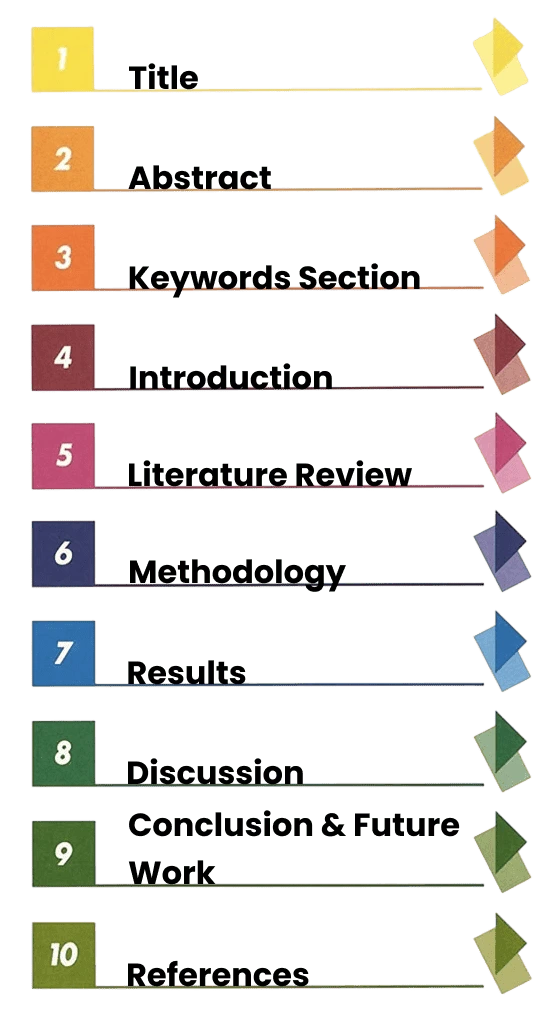
With any given scientific discipline, the formula might be tweaked a little, but for the most part, the backbone of the Journal Paper Format remains just about universal. These components are not arbitrary; they exist to make your research traceable, reproducible, and understandable. Let's unpack the anatomy of a journal paper.
Title Page
It is a page that will give the very first impression of your work. It includes a title of the paper, all authors' affiliations, the contact of the corresponding author, and in most cases, either the running head orthe manuscript ID.
Abstract:
No more than 150-250 words. Summary of your research question, methods, results and conclusions. A reader will know from an abstract whether to read your paper.
Keywords
These are usually 4-6 well-chosen words, enabling your paper to be effectively indexed and retrieved in academic databases.
Introduction
The introduction sets the framework by defining the problem, describing the objectives, and giving the background and justification for your study.
Literature Review
This evidence shows mastery of prior research and identifies the lacuna in the research your study will fill.
Research methodology
This is the plan of your research. At this stage, research design in research methodology plays a very important role. You are to explain how the study has been carried out, from details on data collection to sampling techniques, instruments, and tools of analysis.
Results
This is the representation of the outcome in tables, graphs, and figures. It should be clear, but no interpretation is required here.
Discussion
Here, you interpret findings by relating them to the literature, interpreting patterns and discussing implications
Conclusion
It outlines the major lessons learned from the research, its impact, and how future research may be conducted.
References
This is the list of works cited in a standard citation style, including APA, MLA, or IEEE.
Appendices
Attach supplementary data that may include questionnaires, longer tables, or raw datasets.
Acknowledgment
Contributions from advisors, institutions, or funding bodies should be included here.
Author Contribution & Funding Disclosure
These recently become widely required, and they make clear who did what, disclose funding transparency.
Conflict of Interest Statement
This is a requirement for almost all, if not all, journals to ensure that the reporting of research is ethical.
In this, each of the elements will be performing a specific role: together, they will create the symphony of academic structure that will smoothly guide the reader from hypothesis to conclusion.
Common Types of Journal Paper Formats
Not every journal paper format is the same. Each discipline, and every journal, has its own conventions particular to that area of knowledge or to that publication, reflecting its communication culture. Know which one applies, and it may be the key to your paper's acceptance.
The following are the common formats of metaphor:
APA Format (American Psychological Association)
Like many other social sciences, psychology, and education, APA stresses clarity, conciseness and author-date citation. The headings will fall within the structured five-level hierarchy and the reference list is alphabetized with very particular rules on punctuation.
MLA Format (Modern Language Association)
Works with author prominence and textual analysis, like those in literature, arts, and humanities, especially favour MLA. Since all citations in text are in author-page format, this style is particularly useful if your work relies upon citing specific passages extensively.
Chicago/Turabian Format
This style type is preferred in history, political science, and some humanities disciplines. It supports both the author-date system and the notes-bibliography system. It is characterized by extensive footnotes or endnotes, where an author is able to give full context and commentary.
IEEE Format
It is taken as a standard given in engineering, computer science, and technology because IEEE uses a numerical system of citation like [1], [2], [3]. It is a structural layout for optimum technical data, which should be concise, exact, and data-based.
Other Journal-Specific Formats
Most of these, especially those indexed in Scopus or UGC, have their hybrid version of these styles. Our journal paper formatting services include customized formatting full and exactly to the specifications of your target publication for 100% compliance.
How Our Journal Paper Formatting Service Works
We go beyond setting margins to refine manuscripts for successful publication. Our technical precision and editorial insight provide journal formatting services. Here is what sets us apart:
Abstract and Section Refinement: Structure, academic language, and clarity in the abstract, literature review, and results are improved.
Reference and Citation Management: Citations were checked for style accuracy and cross-referenced against the bibliography.
Editorial support from start to finish: We have experts in almost all fields, ranging from STEM subjects to the humanities, who undertake subject-sensitive editing and formatting.
Compliance with Journal Standards: We are committed to making sure every page out will meet the requirements set by your target journal, hence avoiding several cycles of revision. We don't just format your paper; we engineer it for acceptance.
Conclusion
In the bigger arena of academic publishing, Journal Paper Format stands as a bridge between great ideas and recognized scholarship. A well-formatted paper speaks professionalism, respect for standards, and attention to detail-all constituents driving home your chances of eventual acceptance.
Professional formatting is not just about looking good; it's all about accuracy, reliability, and confidence. You let experts handle it, thus setting yourself free to focus on innovation but at the same time securing that your work turns out submission-ready for any top-tier journal. Because, after all, in research publishing, presentation is power-the right format can transform a great study into a published legacy.